STATISTICS

Pages

REPORTERS WITHOUT BORDERS

REPORTERS WITHOUT BORDERS

Sunday, 21 August 2011

The barra bravas: the violent Argentinian gangs controlling football

Like many of those living in Villa Fiorito, one of Argentina's most dangerous slums, Jose Mendez takes his shots at glory when he can – like the day five years ago when he slung the shirt of a rival football club over his shoulder and paraded through the streets of his neighbourhood like a returning warrior. Cigarette clamped between his teeth and basketball shirt hanging off his skinny frame, Mendez recounts the fight he waged to win his trophy: the crowded streets after a big match; the other fan putting up a struggle; Mendez, pumped up on chemicals and cheap beer, knocking him down into the street, smashing his face and kicking him until he could get the shirt off his back. "I took the shirt," he says. I put it over my shoulder and walked through the barrio with everyone watching." He struts up and down the dirt path outside his family home, replaying his victory march. "After that I was in, they knew how much I loved the club. I was one of them."

As with many poor men across Argentina, football has shaped Mendez's life and his identity. He says football is the one glorious thing in his life, a chink of colour in the monotony of poverty, crime and unemployment that surrounds him and his young family. But recently his devotion has led Mendez down a different path. Since his glory march through the streets of Fiorito, Mendez has become a barra brava, a self-proclaimed soldier for his club and part of a well-organised and violent network of fans that now wields almost unfettered power over the multi-million-pound business of football in Argentina.

In practically every major club side – which includes some of the world's most famous teams – the power of the fans is out of control. Using mob violence and intimidation, Argentina's barras bravas cream hundreds of thousands of pounds from the game every year through illegal rackets, money laundering and narcotics, underpinned by police and state corruption, and supported by the clubs and players themselves.

The only way to understand how Argentina's fans have grown so powerful is to witness them at first-hand. La Bombonera, Boca Juniors's famous stadium, squats in the heart of the working-class La Boca neighbourhood in the south of Buenos Aires. When I go to a match, the whole structure shakes underfoot as trumpets blare and thousands of fans jump and dance in a shower of ticker tape.

Next to me, amid the riot of noise and furious anticipation, a man wearing a Boca shirt is silently praying, face raised to the sky. As the players enter the stadium to an animal roar, he bellows his love for his team into the night. "Boca! Boca! Boca!" he screams, tears running down his face as he reaches his arms out to the tiny figures below. "I love you, I love you."

Down by the pitch in the "popular" stands, La Doce (The Twelfth Player) – Boca Junior's hardcore fan base – are a tight mass of thrashing bodies, twirling their blue and yellow shirts around their heads, dancing, singing and banging drums. As the match starts they surge towards the fence separating the fans from the pitch, bodies slamming against the chain-link, screaming their team on to victory.

Throughout the match La Doce lead the chants; the players on the pitch feed off their adulation and when the crowd grows restless at the sluggish pace, it is to La Doce that they look for support. Yet while La Doce may have the rightful reputation as the world's most passionate fans in a country that has spawned some of the world's greatest players and most exciting club football, they have also evolved into one of the most feared and infamous groups of barra brava in the country.

The more lucrative the club becomes, the bigger the piece of the pie the fans claim. It's estimated the most powerful barras pull in thousands every month through ticket and parking rackets, and by controlling the lion's share of club merchandise and refreshments inside the stadiums. And it doesn't stop there. Gustavo Grabia, an Argentinian journalist who has spent years investigating football corruption, claims the biggest barras also receive up to 30% of transfer fees when a player leaves and up to 20% of some players' paychecks.


For ordinary men such as Mendez, the message of the barras bravas is that everybody can benefit, as long as they don't mind getting their hands dirty. "For me it was like a dream, to go to the match every week, to be someone," he explains. "At the games we're welcomed like heroes. You don't need to go through security, you don't need to answer any questions." He stops and raises his hands in a victory salute. "In there we're like the kings of the stadium!"

He agreed to speak to me on condition I change his name. If the bosses find out he's speaking to a journalist, there'll be hell to pay, he says, cocking his fingers into the shape of a gun and blowing an imaginary bullet into his head. "These people, the bosses who run the barras bravas, they don't care who you are, if you cross them, they will hunt you down and come after you and your family."

Football in Argentina has always been bloody, but in the past decade things have escalated. An estimated 190 people have now died in football-related incidents in Argentina, 14 in the past 18 months. In 2002, after a particularly bloody season saw five people killed and countless others left with gunshot and knife wounds, the Argentinian government declared violence in football a national emergency.

In recent years, the violence has shifted away from the terraces into the streets of the capital as rival barras fight for control in a blaze of fire fights, drive-by shootings and mafia-style executions. Despite the violence, Mendez still believes he is taking part in something glorious. "What else do we have to be proud of if it isn't our team or the club shirt on our backs?" he asks. He gestures angrily around his house, at the crumbling walls, the damp mattresses where his six children sleep, the curling football posters and flickering light bulbs. He takes me outside and points to two teenagers sitting under a faded mural of Villa Fiorito's most famous son – Diego Maradona. For a few pesos, locals take tourists to see the pitch where he honed his skills, now nothing more than a patch of cracked, weed-clogged concrete, or to look at the rubbish-strewn front yard of the Maradona family house.

The two boys lean back against the cracked paint and smoke paco, a cheap, toxic mix of cocaine base paste. The drug has become endemic in Argentina's poorest barrios, claiming countless young lives every year. "Those two boys, they used to play football with my sons," says Mendez. He points to one of them; what was once a leg is now a stump wrapped in dirty bandages. "That kid, he was so high on that stuff he lay on the railway tracks and was hit by a train. In a year they'll both be dead."

For Mendez, Maradona is proof of the transformational power of football. Here, he says, nobody but the footballers leave the villa. "Maradona grew up in these streets," says Mendez. "I remember him playing football and everybody knew he was a genius. He was given a gift and he got his whole family out. Carlos Tevez, he was the same. He came from nothing and now he's a superstar."

Despite his best efforts, Mendez hasn't made a particularly good barra soldier. He's hung around on the fringes of the organisation, but never made any real money. Now that he's promised his wife he'll quit the booze and drugs, he has neither the constitution for violence nor the head for business.

A few days later he takes me to meet someone who does. We travel across town to an abandoned railway siding to meet Pepe Diaz (not his real name) a father of three. According to Mendez, Diaz can tell me everything there is to know about the inner mechanics of Argentina's new football mafia. When we arrive Diaz is working. On his belt a mobile phone buzzes relentlessly. "It's going to be a big one," he says, rubbing his hands. "Big game, big money."

Unlike Mendez, Diaz has shown a remarkable aptitude for business and has moved quickly up the ranks. Throughout our conversation he exudes a sense of ownership over his team, which has grown from the poor streets in the south of Buenos Aires to become one of the best known in the world. For Diaz the barras bravas are doing nothing more than taking what is rightfully theirs. "Here in Argentina we are football, it belongs to us," says Diaz. "The players, the clubs, they owe everything to us. Why should we sit back while the suits get rich? We are just taking our cut."

Like Mendez, Diaz was born and raised in Argentina's slums. Now he's raising his young family there, too. During the week he feeds them by working as a cartonero, dragging a cart past the tango halls and steak restaurants of downtown Buenos Aires, picking up discarded cardboard for recycling. "I walk around the city every night and people look straight through me like I don't exist. As a poor man, I'm invisible. At the weekends it's different. People see us. People see me."

Diaz is proud of how efficiently his barra is running the business of football. "In England you think your fans, los hooligans, were powerful but they were nothing compared to us. All you did there was drink and fight. We drink, we fight and we also do business. We're not just monkeys singing for the clubs in the stadiums and then killing each other in the streets. They could learn a thing or two from us."

Squatting on the ground with a bottle of beer in one hand, Diaz draws circles in the dirt to map out the regimented hierarchy of the barra brava. At the top are the bosses – the half-dozen ruthless men who rule through fear. Each is estimated to make up to 100,000 pesos (£70,000) a year in a country where 30% of the population live below the poverty line. Down at the bottom are the ordinary neighbourhood men and football fanatics who are given free beer, amphetamines and dope and then dispatched to the matches to sing for their side and do the bidding of the bosses in the streets. In the middle are men like Diaz who are increasingly making the barras bravas a criminal force to be reckoned with. "I had to show my loyalty to the club, so at first it was just the fighting, showing you're willing to do what it takes," he says. "Then when they trust you, you can start to get involved with the money. Then you're really part of it."

Like most barra soldiers, Diaz started by roaming the streets around the stadiums charging fans 40-60 pesos (£8-10) to park their cars near the stadium. He proved a natural at persuading people to part with their cash and estimates he made about 2,000 pesos (£300) in commission per game. "First you start off doing the parking, then you move on to flogging tickets outside the game," he explains, alleging that during the matches he runs guns and drugs, mostly speed and marijuana, through the stands. "Inside the stadium is where a lot of the real action happens, because in there we're basically untouchable. We can do whatever we want. It's our territory."


If Diaz is telling the truth, it seems unlikely that any of this could happen without the complicity and collusion of the clubs, the players and the police, a situation that has been the subject of much speculation and report both inside and outside Argentina. In the 1950s the barras started out as groups of dedicated fans who were given shirts and free tickets by club officials who needed to secure votes by season-ticket holders to get elected to club boards. Once they had their foot in the door, the fans' demands increased and their willingness to resort to disruptive violence saw their grip on the clubs tighten. The problem for those trying to break the power of the fans is that too many people are benefiting from their rise to dominance.

Carlos de los Santos is from Argentina's new Security Unit for Live Sporting Events, which the government set up to deal with mounting violence in the game. He looks weary when I ask him why there has been so little progress. "Corruption is endemic in Argentina and it is what has allowed the barras to get so powerful," he says. "The problem is that everybody is taking a cut. It won't help just throwing the barras bosses in jail, we've tried that. To break the barras you have to sever their political connections and root out those police complicit in their activities, and this is going to be hard. In fact in the current climate I don't see how it's going to be done."

In the absence of any decisive action from the authorities, it's come down to those who have been most touched by the violence to fight back. Argentina's frontline in the war against the barras bravas comes in the unlikely form of Liliana Suárez de García, a softly spoken woman in her late 60s. On her lapel is a badge bearing the face of her son, Daniel, killed outside a game in Uruguay during the Copa America in 1995. For years after his death she fought for those responsible to be brought to justice, until she realised there were dozens of other families also losing sons. Now, as president of her own organisation, Familiares de las Victimas de la Violencia en el Futbol Argentino (Families of the Victims of Violence in Argentinian Football), she has emerged as one of the only voices calling for action.

"Every day I wake crying for my child," she says, wiping her eyes. "His death was so tragic, but nobody helped me, there has been no justice because those who killed him have the protection of the police and of the state. It has to stop because at the moment those who are profiteering are getting away with murder."

When I ask Diaz about the tangled web of vested interests underpinning the barra's control over the game, he looks blank. "They use us, we use them, it's the way it's done," he says, with a shrug. "Police get paid, politicians get paid, and everyone wins. When they need muscle they have it, when we want money or access to players then we get it. If the clubs don't think a player is doing his job properly or not paying out we'll have a word or his girlfriend or wife might be threatened with kidnap."

"You physically attack the players?" I ask.

"Only if they need a talking to," says Diaz. "Just to let them know who's boss."

But life as a barra brava comes at a cost; as profits soar, the barras are turning on each other. Last year rival gangs within La Doce turned part of downtown Buenos Aires into a war zone, wounding several terrified bystanders.

Diaz now sleeps with a gun beside his bed. "Of course the dangers get greater as you get more powerful, but that's the risk," he says. "I think about quitting, but then as soon as I get on the bus at the weekend and the booze and the drugs are flowing and the drums are banging and you're singing for your club, it's the best feeling in the world."

Mendez has a different story. Recently life within the barras has become too much and he wants to get out. "It's one thing when it's just parking rackets and ticket sales, but now it's too heavy," he says. Last year he and his family were caught in the middle of a violent battle for control of the drug trade in Villa Fiorito, with the traffickers on one side and the barra brava of another club on the other. "My baby son was outside and they were running up the street firing at each other. I threw myself on top of him and we could hear the bullets as they went over our heads. When you're with the barra you're somebody. Without them, I'm just another poor guy who can't feed his family. But at least I'll be alive."


Belfast family targeted by kidnappers have been left deeply traumatised.


Police investigating the terrifying tiger kidnapping where the partner and son of a security van driver were taken from their home have refused to rule out dissident republican involvement.

Two masked and armed men forced their way into the south Belfast home in the Teeling Grove area of Dunmurry on Wednesday at around 6pm.

His partner and 16-year-old son were abducted in a white Transit van and taken to Castleblayney, Co Monaghan, and held hostage overnight.

The next day the man handed over a “substantial” sum of money, believed to be £200,000, to the kidnappers.

More than 24 hours later the woman and teenager were found alive locked in a shed in Co Monaghan.

The kidnappers then set the van, used to transport them, on fire. The blaze was spotted by someone who contacted the gardai and the victims were found at around 8pm on Thursday.

Both gardai and the PSNI have now launched a joint operation.

Police said they have not ruled out dissident involvement and that “all lines of investigation will be pursued”.

Detective Chief Inspector Justyn Galloway said they believed more than two men were involved in the kidnapping.

“My early assessment is that this has been a well-planned and organised kidnapping and robbery and we are dealing with a criminal gang,” he said.

“Certainly, more than two persons were involved in this,” he said. “I have no doubt that a number of persons are involved in the planning and execution of this incident.”

Police want to trace two vehicles used by the gang, a white van spotted at Teeling Grove on Wednesday, registration: HEZ 6069.

They also want anyone who saw a brown/beige hatchback in the area of Muckamore Industrial Estate at around 5.20pm the following day to get in touch.

Mr Galloway said although the family were not injured, they were left traumatised.

“The family are deeply traumatised, you are dealing with a 16-year-old boy and two adults who had the terrifying ordeal of being removed and kept at a location overnight,” he said.

“It was clearly a traumatic incident that they went through.”

He added: “They were left in no doubt that if they did not co-operate and comply with the instructions that there lives would be in danger.”

The incident has led to cross-party condemnation.

Alliance MLA Trevor Lunn described it as an “extremely traumatic and horrific ordeal” for the family.

“They are callous thugs who are offering nothing to our society,” he said.

SDLP councillor for the area Brian Heading said: “It is disgusting that a man out trying to earn an honest living for his family has, along with his partner and son, been targeted and made to suffer in this way.”

Sinn Féin’s Jennifer McCann said the criminal gang involved in the attack need to be apprehended immediately.

“This type of criminal activity has no place in society and I would ask anyone with any information to pass it on to the PSNI,” she said.

Background

Tiger kidnappings — when gangs seize families of bank officials or keyholders of businesses as collateral until the victim has met their demands — are a familiar tactic used by paramilitaries and criminal gangs in Northern Ireland.

The incident in Teeling Grove, Dunmurry is the fourth such kidnapping to take place in Northern Ireland in 2011.

Called a tiger kidnapping because of the predatory stalking that precedes the crime, it often requires considerable inside information about the target.

One of the most high-profile cases was in 2004, when Northern Bank employees were forced to help a gang take more than £26m from the bank's central Belfast vault. In 2006 the PSNI reported a sharp rise within a year for tiger kidnappings with 11 cases occurring in 12 months.

In December 2008 a masked five-man gang armed with guns took over the home of a Marks and Spencer employee at Hannahstown on the outskirts of west Belfast.

Normal day that turned into a nightmare

What began as a normal day for a family of three in Dunmurry ended in a horrific and frightening 24 hours.

The traumatic ordeal of the victims’ — a father, his partner and his 16-year-old son — began just shortly after 6pm when they had just sat down to eat.

Two armed and masked men burst into their house in the Teeling Grove area of Lagmore.

The nightmare for the family would not end until 8pm the following day.

The armed men stayed no more than one hour at the house, issuing clear and concise instructions to the victim.

He had to go to work as normal to money courier firm Brinks-Mat the next day, then meet the gang at a specific location and hand over a ransom — thought to be £200,000.

If the instructions were not followed it was made clear the three victims’ lives would be in danger.

The criminals were aware of the hundreds of thousands of pounds he would have access to during his daily job.

The company collects and delivers large sums of cash to banks and other financial institutions in Northern Ireland.

After the instructions were given they abducted the man’s partner and son, forcing them into a white transit van outside.

Placing pillow cases over their heads, the frightened woman and teenager were driven away.

The next day, following the instructions, he attended work as ‘normal’ on Thursday.

At around 5.20pm he made his way to the meeting point in Raceview Industrial Estate in Muckamore, Co Antrim.

He handed over the ransom to the men who were in a brown/beige hatchback car.

His partner and son, meanwhile, had been taken from Belfast to Mullyash, near Castleblayney, in the back of a van.

It is not clear where they stayed overnight but they were fed by their captors.

The nightmare finally came to an end after Gardai, responding to a call that a vehicle was on fire found them.

It is believed they were found in a nearby shed.

The Gardai contacted the PSNI who launched an investigation into the incident.

PSNI Investigating officer, Detective Chief Inspector Justyn Galloway, said the family are now being extensively interviewed by officers in a bid to help track down the kidnappers.

Mr Galloway said while the family were not hurt, the incident had left them traumatised.

“The victims were in their own house and then faced with masked men holding guns, terrifying by any account,” he said

The phone-hacking scandal took a new twist on Friday as police said they had arrested a detective suspected of leaking information about the investigation into the News of the World.


Police separately said a 14th person, reportedly a former journalist at the now defunct tabloid owned by Rupert Murdoch, was arrested in connection with the original probe into the illegal hacking of mobile phone voicemails.
The Metropolitan Police Service (MPS) said in a statement that anti-corruption officers had arrested a 51-year-old officer working on Operation Weeting, the force's phone-hacking investigation.
Sky News television said he was accused of leaking information to The Guardian, the newspaper which has long been investigating the hacking at the News of the World.
"Officers from the MPS Directorate of Professional Standards Anti Corruption Unit have arrested a serving MPS officer from Operation Weeting on suspicion of misconduct in a public office relating to unauthorised disclosure of information as a result of a proactive operation," it said.
"The male detective constable, aged 51 years, was arrested at work yesterday afternoon. He has been bailed to return on 29 September 2011 pending further inquiries," it said.
The officer has been suspended as of Friday, the statement added.
Deputy Assistant Commissioner Sue Akers, the officer in charge of Operation Weeting, said the development was "hugely disappointing".
"I made it very clear when I took on this investigation the need for operational and information security. It is hugely disappointing that this may not have been adhered to," she said.
The owner of The Guardian, Guardian News and Media, said it "noted" the detective's arrest.
A spokeswoman added: "Journalists would no doubt be concerned if conversations between off-the-record sources and reporters came routinely to be regarded as criminal activity.
"In common with all news organisations we have no comment to make on the sources of our journalism."
In a separate statement, police said they had arrested a 35-year-old man by appointment on Friday at a London police station. He was bailed to return in October.
Britain's Press Association news agency named him as Dan Evans, a former News of the World feature writer previously sued by the stepmother of actress Sienna Miller over hacking.
James Desborough, the former US editor of the News of the World, was questioned by police over phone hacking on Thursday before being released on bail until October.
Police began investigating phone hacking in 2006, a probe which resulted in the jailing of private detective Glenn Mulcaire and the News of the World's royal editor Clive Goodman the following year.
Despite a steady stream of new claims, police did not reopen the probe until January this year.
A string of high-profile figures have been arrested, including former News of the World editors Rebekah Brooks and Andy Coulson, who also worked as Prime Minister David Cameron's communications chief.
The scandal has already caused the closure of the News of the World after 168 years and the resignation of the Metropolitan Police's two top officers.

James Desborough is fourth NOTW journalist recruited from 'The People' to be arrested, following Neil Wallis, Ian Edmondson and James Weatherup

The US editor of the News of the World, who provided the paper with a string of showbusiness scoops on both sides of the Atlantic, yesterday became the 13th person to be arrested by police investigating phone hacking at the now defunct Sunday tabloid.
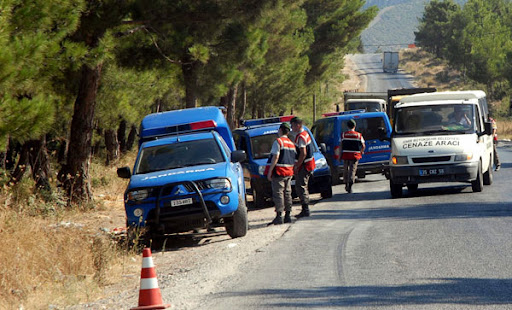
James Desborough, who became the newspaper's Los Angeles-based correspondent in 2009 after winning an award as Britain's best showbusiness reporter, flew back from America to be arrested by appointment at a south London police station by officers from Scotland Yard's Operation Weeting on suspicion of conspiracy to intercept voicemails.


The 38-year-old is the first NOTW journalist working in America to be detained as part of the phone hacking scandal – prompting an excited reaction in the US – although it is understood that his arrest relates to his work for the paper while still working in Britain. He joined the NOTW as a showbusiness reporter in 2005 from its rival Sunday tabloid, The People.

In a statement, Scotland Yard said: "Officers from Operation Weeting have arrested a man on suspicion of conspiring to unlawfully intercept voicemails. He was arrested by appointment at a London police station and remains in custody."

Mr Desborough is the fourth journalist recruited from rival Sunday red-top The People to the NOTW under the editorship of former Downing Street communications chief Andy Coulson to have been arrested by officers from Weeting.

Neil Wallis, who joined the NOTW as deputy editor in 2003 from the Trinity Mirror-owned People, was arrested last month on suspicion of conspiracy to hack phone messages.

His former assistant editor at The People, Ian Edmondson, became one of the first journalists to be arrested by Weeting when he was detained in April following his dismissal from the NOTW four months earlier. James Weatherup, an assistant editor at the NOTW who was also arrested by Weeting officers in April, had worked alongside Mr Desborough, Mr Edmondson and Mr Wallis at The People.

Mr Desborough was considered to be one of the paper's best-performing journalists in the high-pressure world of Sunday tabloids, regularly beating rivals to showbusiness stories and notably scoring successes in his coverage of the break up of the marriage of Sir Paul McCartney and Heather Mills.

He was named showbusiness reporter of the year in the 2009 British Press Awards and was appointed the paper's US editor shortly afterwards. He was presented his award by Jon Snow, the Channel 4 News presenter.

Living in Hollywood and deploying the tactics of Britain's famously battle-hardened tabloid entertainment correspondents, Mr Desborough won plaudits for his work. His revelations about the investigation into the death of Michael Jackson included one story with the headline "Jacko had cocaine in his pants".

His arrest is the latest link between the phone hacking scandal and America. The Murdoch-owned Wall Street Journal reported this week that American authorities have widened their inquiry into News Corp to establish whether there are grounds for investigating corporate wrongdoing at the media giant's US subsidiaries.

But the paper said a separate inquiry by the FBI into claims that NOTW journalists tried to instruct a private investigator to hack the phones of victims of the 9/11 attacks had so far failed to find any "hard evidence" to substantiate the allegations.

'No celebrity with secrets can sleep easy'

When James Desborough was named Britain's best showbusiness journalist in 2009, the judging panel was in no doubt about its reasons for giving him the award. Its citation praised him for "uncompromising scoops which mean no celebrity with secrets can sleep easy".

After working for more than a decade in the PR-infested world of entertainment reporting, the News of the World hack had indeed secured a number of exclusives that would have been valuable to his editors. They included the revelation that Fern Britton, who claimed to have lost a large amount of weight by dieting and exercise, had in fact undergone gastric band surgery. Mr Desborough also broke the news that Peaches Geldof, daughter of Bob Geldof, was obtaining a divorce after a Las Vegas wedding.

But the reporter has not had an unblemished record. The NOTW paid an undisclosed sum to Angelina Jolie and Brad Pitt last year after it published a story written by Mr Desborough wrongly stating that the couple had split up. The journalist has insisted that his stories are not the result of cosy deals with publicists. After receiving his British Press Award in 2009, he said: "A lot of deals are done these days between PRs and papers... These stories were all old-fashioned journalism where we said: 'We know this to be true; would you like to comment?


Maltese ship heading for Tripoli under fire

A Maltese ship heading for Tripoli to pick up refugees came under fire and could not dock in the port, Polish foreign ministry officials were quoted as saying on Sunday by Polish state news agency PAP.

"The ship is waiting for a better moment to enter the port because during its first attempt it came under fire," Paulina Kapuscinska, a spokeswoman from the ministry, told PAP.

The ministry was not immediately available to confirm the report.

Poland has evacuated most of its citizens from Libya and moved its ambassador from Tripoli to rebel-held Benghazi, but some 250 people from mixed Polish-Libyan families have stayed behind, the ministry official added.

One family had hoped to leave on the Maltese ship, the MV Triva 1.

Heavy fighting in Libya's capital broke out late on Saturday between rebels and remnants of Muammar Gaddafi's forces as the rebel forces try to capture the capital Tripoli.


I'll bring our girls home says former partner of Turkey murder victim as local waiter confesses to crime

THE former partner of a woman stabbed to death with her best friend in Turkey has left Ireland to bring home their bodies.
Marion Graham and Kathy Dinsmore, both 53, from Newry, Co Down, are believed to have been murdered by teenage waiter Recep Cepis, who had been dating Marion's 15-year-old daughter Shannon.
Raymond McGuinness, Shannon's father, flew to Turkey yesterday to comfort his daughter.
He will also bring home Marion and Kathy's bodies.
Raymond admitted he had never been fully in favour of the relationship since the teens began going out last summer.
He added: "There was always something that was not quite right."
Marion and Kathy's bloodsoaked bodies were found in woods 75 miles north of Kusadasi. They had been stabbed and their throats cut.
Turkish sources say the killings were sparked after Marion refused to allow 17-year-old Cepis to marry Shannon.
Cepis, known to the family as Alex, has confessed to the killings after initially claiming the women had been kidnapped.
The teenager has been quizzed by a prosecutor and remains in custody. His father and a taxi driver were also arrested, but have since been released.
Marion and Kathy spent their summers in Turkey and Cepis began dating Shannon last year.
He is thought to have driven his victims out of Kusadasi on Thursday after Shannon went on a boat trip.
He had told Marion and Kathy he was taking them on a shopping trip. The alarm was raised when he arrived for work "in a distressed state" and claimed the women had been kidnapped.
He claimed he had tried to fight off kidnappers who had bundled Marion and Kathy into a van.
Raymond said: "He told Shannon he had tried to stop the kidnappers and had suffered a cut on his hand."
It is understood Cepis had been involved in a separate row with Shannon's mother last week.
He has already appeared at a preliminary court hearing but is yet to be formally charged.
Turkish police have yet to decide whether he will be tried as an adult or juvenile.
Marion's sister Monica Higgins said yesterday the family were "absolutely devastated" by the tragedy.
She added: "We've just found out. My mother's in the car crying her eyes out.
"We're trying to work with the Irish Department of Foreign Affairs to find out what exactly happened."
Shannon was comforted through the day by a Kusadasibased Irish hotelier at a police station in Izmir. An Irish Embassy official has also been sent from Ankara to support her.
Tragic Kathy, whose mother died just four weeks ago, worked for Newry and Mourne District Council. She worked in a local cab firm up until last Christmas.
The two women had been regular visitors to Kusadasi for years, staying in an apartment owned by Raymond.


Friday, 5 August 2011

A British adventurer has been killed by a starving polar bear which attacked an expedition organised by the British Schools Exploring Society.


Four other people were injured by the animal, which the group then shot dead, at the Von Postbreen glacier on the island of Spitsbergen, part of the Svalbard archipelago.
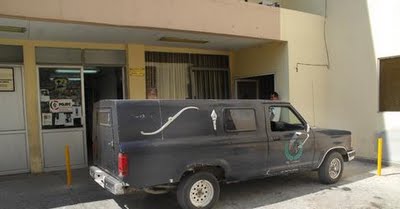
The party of around 80 were on a five-week expedition in the Arctic run by the BSES, a youth development charity.

The group alerted the authorities by satellite phone at 7.30am on Friday and the injured were airlifted by helicopter to hospital 25 miles away in Longyearbyen, the island's capital.

The four, including the two leaders of the trip, were named as Michael Reid, Andrew Ruck, Patrick Flinders and Scott Smith. They are due to be flown to University hospital in Tromso on the Norwegian mainland on Friday afternoon.

The BSES, which is based in Kensington, west London, has so far not released the name of the dead person.

A spokeswoman said: "There were about 80 people all told in the expedition. The young people are all between 16 and 23."

Liv Asta Odegaard, a spokeswoman for the governor of Svalbard, said: "We got a call via satellite phone from a British group of campers that there had been a polar bear attack and that one person was dead and that others were injured and they needed assistance.

"There are no roads in the area of the Von Postbreen glacier where the incident happened so we scrambled a helicopter."

The hospital said the boys had "moderate to serious skin injuries".

The BSES tour had been organised to introduce youngsters aged between 16 and 20 to "remote, wild environments to develop their confidence".

One expedition member, Marcus Wright, posted on a website last week: "I think we must have all dreamed of polar bears because the next day we were eagerly waiting for the ice floes to break up so we could move on to base camp.

"There was a P.bear sighting across the fjord about a mile away. We encountered another P.bear floating on the ice. This time we were lucky enough to borrow a kind Norwegian guide's telescope to see it properly.

"After that experience I can say for sure that everyone dreamed of P.bears that night."

The Arctic adventure expedition 2011 began on July 23 and was scheduled to run until August 28.

Students were told they would "venture into the untouched beauty and wilderness of Svalbard".

A blog charting the trip said the group would camp by the southern edge of the glacier, 400 miles to the north of Norway.

It read: "Once settled at base camp, you and your fire will move onto your fieldwork objectives – to enable this will be a healthy dose of adventure including glacial travel, snow shoeing, ice climbing and mountaineering dependent on your research plans.

"Once back at base camp there may be opportunity to walk back to Longyearbyen over 4 days with much lighter packs carrying essential supplies only, this carries on the BSES tradition of 'the long march'.

"This period will allow for personal reflection of your achievements and enjoyment of the green tundra after the snow and ice of the last weeks."

Earlier this year the Svalbard governor issued a warning about polar bears after several were seen close to Longyearbyen.

People who spotted the animals were asked to telephone a special number. The governor also reminded the public that seeking out and disturb polar bears violates local regulations and was punishable by a fine or jail.

Liv Rose Flygel, 55, an artist and airport worker who lives near the hospital, said: "It's not been the first time.

"Last summer a man was attacked by a polar bear and there have also been attacks on a man from Austria and a girl. Only the man in the attack last summer survived.

"The problem is when the ice goes the bears lose their way and cannot catch food. People don't really know how dangerous they are; one came down to the sea recently and people were running down to take pictures."

Sandra Swresser, a restaurant manager at Kroa bar in Svalbard, said: "It's very sad. We have had attacks before, it happened a year ago when a Norwegian man was attacked. As it was early in the morning I can only suppose the bear attacked them because it was looking for food."

A local source said: "This was a horrific attack. They are saying the bear was extremely hungry."

Dwindling sea ice in recent years has led to polar bears, which usually hunt seals, looking inland for food, including from the eggs of barnacle geese on the island.

Prince Harry visited Spitsbergen in March as part of a charity hike to raise money for British veterans with The Walking with the Wounded Team.

A spokesman for the British Foreign and Commonwealth Office said: "Our embassy in Oslo is urgently looking into reports of an incident in northern Norway."

Thursday, 4 August 2011

More Journalists Killed in Mexico’s Drug War than in Afghanistan

For journalists covering the war on drugs beat in Mexico, a sojourn in war-torn Afghanistan might be a real treat:
A tally kept by the Committee to Protect Journalists shows attacks on reporters have intensified since President Felipe Calderon launched an army-led crackdown against drug gangs at the end of 2006. More than 40,000 people across Latin America’s second-biggest economy have died in the conflict.

At least Mexican 42 journalists have been murdered over the past five years, according to the CPJ, making it more deadly than Afghanistan.

Mexico’s human rights commission puts the number at 50.

Notably, for all this death and violence, the supply of drugs coming up from Mexico remains strong. Meanwhile, the Mexican press is intimidated – and not just by the cartels:

As they hunker down to work, reporters face an increasingly impossible task.

They often receive threats to hush up the capture of drug suspects because it makes the cartels look weak.

At the same time, gangs regularly alert the media to spectacular killings carried out by their hitmen. They often leave messages for their rivals on the bodies of their victims and then pressure local journalists to transmit those threats.

There is virtually no local news coverage of the violence in Tamaulipas, even when rival cartels go at each other in fierce street battles.

Reporters say the intimidation from soldiers is escalating and in some areas is as bad as, or even worse than, the pressure from gang leaders.

"With no search warrant and in a car with its plates blacked out, soldiers arrived at my office … and tried to take cameras and everything," said a journalist from Nuevo Laredo, just over the Rio Grande from Texas in Tamaulipas.

The War on Drugs is failing. In America it has led to mass incarceration and violence. In Mexico it has led to the deaths of tens of thousands of Mexican citizens. Nobody is winning and nobody will, and the flow of drugs will never stop. So long as there is a demand for drugs, the black market will find a way to supply it.


Thursday, 21 July 2011

The Duke of York is to step down from his role as the UK's roving business ambassador, Buckingham Palace confirmed tonight.


He will give up the post following the intense scrutiny he faced earlier this year over his relationships with a series of controversial figures, including a convicted paedophile.

The Duke has been dogged by accusations of a lack of judgment about his links with American billionaire Jeffrey Epstein, who was sentenced to 18 months in prison in 2008 for soliciting a minor for prostitution.


The Duke has been dogged by accusations of a lack of judgment about his links with billionaire Jeffrey Epstein (right), who was sentenced to 18 months in prison in 2008 for soliciting a minor for prostitution


Andrew has been the UK's Special Representative for International Trade and Investment since 2001. Here he is seen at a presentation in Hong Kong

A Buckingham Palace spokeswoman said: 'The role as Special Representative will no longer exist as the Duke of York has decided to relinquish it after 10 years.'

The spokeswoman stressed that Andrew would continue to undertake official overseas trips as a member of the Royal Family in support of Britain's foreign interest.

Further doubts were raised about Andrew's position in the wake of media coverage about him entertaining the son-in-law of ousted Tunisian president Zine El Abidine Ben Ali at Buckingham Palace.

 
But as the criticism mounted in March, he received the backing of Prime Minister David Cameron and Chancellor George Osborne.

Andrew has been the UK's Special Representative for International Trade and Investment since 2001, travelling around the world and at home promoting Britain's business interests.


But there have also been long-running complaints about the lavish nature of his official foreign trips.

However, he is set to continue to work on home-based trade matters.

A source told the Daily Mail: 'With No.10 keen to develop the skills agenda and Andrew determined to use the knowledge he has built up over many years in his trade role, this seems the most sensible way forward.

'He will continue to bang the drum for UK plc, but it will be in terms of promoting business opportunities here, especially in the science and engineering fields.'

Calls for the Duke to resign or be removed from his role were made in March by Labour MP Chris Bryant, a former Foreign Office minister, and senior Labour backbencher Mike Gapes.


A leaked letter written by retired diplomat Stephen Day, a former ambassador to Qatar and Tunisia, to Foreign Secretary William Hague stated that an 'entirely new role should be found for him as soon as possible'.

At the height of the media interest the Duke pulled out of a business trip to Saudi Arabia.

But Buckingham Palace sources stressed the decision was 'nothing to do' with the press coverage and was made for safety reasons.

Andrew appeared to weather the storm and carried on with his public duties. He flew to Indonesia in April for a three-day business visit.

Tuesday, 19 July 2011

Malcolm Hughes is accused of driving his Land Rover at an Army helicopter

A gamekeeper could have killed two Army helicopter pilots when he drove his Land Rover straight at the low flying aircraft, a court has been told.

The pilot of a squirrel helicopter avoided disaster when he saw Malcolm Hughes' car driving towards him.

Lt Andrew Higgins was flying just 10ft above a field as he prepared to carry out a manoeuvre in Pewsey, Wiltshire.

Mr Hughes, 61, of Raffin Lane, Pewsey, denies acting in a manner likely to endanger aircraft. The case continues.

Lt Higgins was flying with trainee pilot Bombardier Henry Luck when he spotted Mr Hughes on 9 December 2009.

Prosecutor Justin Gau told jurors at Salisbury Crown Court: "They saw the defendant's Land Rover driving underneath the helicopter itself.

'Intentionally driven'
"It remained there and then drove off a few yards and the defendant was seen gesticulating angrily and making signs that the vehicle should depart.

"It was clear and quite intentional the Land Rover had been driven at the helicopter."

Mr Gau added that had the helicopter been hit by the car "a fatal crash would have occurred".

The helicopter had taken off from Middle Wallop airbase in Hampshire on a route which was used by the Army Air Corps every three months.


Lt Higgins told the court he saw Mr Hughes' Land Rover beneath his helicopter
As the helicopter approached the field, Mr Gau said, Lt Higgins dropped to 20ft and then carried out safety checks before dropping to 5ft.

It was as the helicopter descended to 5ft that the Land Rover was driven towards them and they had to take evasive action, Mr Gau said.

Mr Hughes maintained he had not got closer than 300 metres and was only trying to get the aircraft's serial number.

"What we say he was doing was one step further than taking their details - he was telling them to get off his land."

Giving evidence, Lt Higgins said he was just about to descend to 5ft when his colleague raised the alarm.

Driver gesticulated
"He suddenly said stop at about 10ft as we started to descend," the officer said.

"As soon as he said stop I looked to the direction he was looking and about half a second later I saw a Land Rover driving underneath the helicopter.

"It moved forward towards the other side of the field and stopped and the occupant gesticulated for us to depart."

But under cross-examination, Stewart Patterson, representing Hughes, suggested to Lt Higgins that he had not looked properly before descending.

He said: "If you had been keeping a proper look out before the last descent you would have seen it?"

Lt Hughes replied: "Yes, in those circumstances."


Saturday, 16 July 2011

Mick Jagger, who had never taken LSD, went on TV to condemn the News of the World and filed a libel suit.

In early 1967, the News of the World, the British tabloid that recently closed down because of the phone hacking scandal, reported that Mick Jagger had taken LSD. He had also consumed six Benzedrine tablets in front of reporters, the paper said, and shown off a lump of hashish.
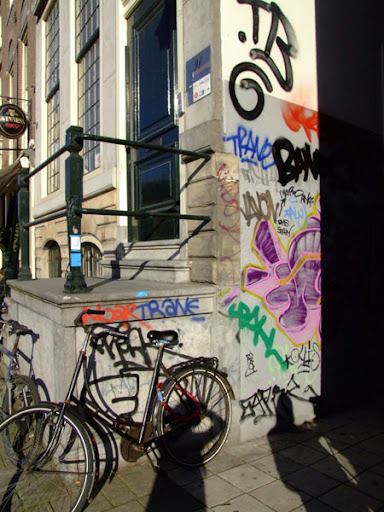
The story was entirely false. It was just possible that the News of the World’s reporters had seen Brian Jones, another Rolling Stone who had a serious drug problem, consume the drugs and had confused him with Jagger. In 1967, Fleet Street reporters could not always tell long-haired pop stars apart.
Jagger, who had never taken LSD, went on TV to condemn the News of the World and filed a libel suit.
This was the cue for a systematic campaign of harassment and surveillance. An unmarked van was parked in the road behind Jagger’s flat at odd hours. His phone sounded tapped. And he had the sense that someone was watching him.
The surveillance came to a head one weekend when Jagger, Marianne Faithful, his then girlfriend, and various other friends were at Keith Richards’ country house, Redlands. As the gang hung around listening to Bob Dylan on the stereo, the police burst in. They had information that there were drugs on the premises, they declared, and proceeded to conduct a raid while Dylan blared on the stereo: “Everybody must get stoned….”
They found nothing on Jagger but Robert Fraser, a friend of the Stones, was found to have 24 government-issue Spanish heroin tablets on his person. “They are insulin tablets”, he said straight-faced. “Right” said the policemen and returned them while continuing to look for evidence of drug use by the Stones. Another friend, who had a bag full of acid, escaped detection because he told the police that the bag contained valuable exposed film and could not be opened. “Okay sir,” said the officers and moved on.
All they found to tie Jagger to drugs were a few speed pills, legal on the Continent, but which had been outlawed in England a year before. They belonged to Marianne but Jagger gallantly said they were his so that she would not be arrested.
The Stones were charged with drug possession and Jagger sentenced to a year in prison (the maximum sentence for possession of speed). The police said they had received a tip about drug use at Redlands and sure enough, the tip came from the News of the World.
Later it was discovered that many policeman (and one inspector in particular who also launched a campaign of persecution against John Lennon) had been paid off by the News of the World. Corrupt links between the police and the paper ran deep. And the rule of thumb was: if you sued the News of the World, it would send the cops to get you.
I dredge up this ancient history (and it is really ancient but also a little ironic – who would have thought, in 1967, that the Stones would outlast the News of the World which was already a century old then?) to put the current News of the World controversy in perspective.
It has frequently been suggested that the recent phone hacking scandal marked a new low in British tabloid journalism or even, that things were fine till Rupert Murdoch came along. In fact, as the story of the Stones bust demonstrates, the News of the World — and much of Britain’s tabloid press—- has been doing this sort of thing for several decades now.
Illegal surveillance has been part of the tabloid press’s journalistic repertoire for as long as I can remember. And while there is shock and horror over the suggestion that the News of the World paid off Scotland Yard officers in the last few years, the truth is that police corruption in Britain is actually less prevalent today than it was in the Sixties when cops were in bed with gangsters, ran porn rackets and raided anybody that Fleet Street wanted them to harass.
Moreover, the Murdochs did not own the News of the World in 1967 so to suggest that great British journalistic traditions were compromised by Australian intervention is just silly. This is the sort of thing that a section of Fleet Street has always indulged in.
If you’ve missed the controversy, here’s what happened: a steady stream of revelations over the last few years suggest that reporters at the News of the World illegally hacked into the phones of upto 4,000 people, checking on their voice-mails and perhaps, listening to their conversations. The list of those whose phones were hacked (often by private detectives working on behalf of the paper) included politicians, sports stars, actors, other journalists and anybody else who happened to be in the news at the time.
Though the revelations have been emerging for five or six years now, they had little impact on the News of the World or the Murdoch empire because the paper was able to claim that they were the work of a few rogue reporters. Some heads did roll but all those sacked soon found work elsewhere. A former editor of the News of the World, Andy Coulson, actually went on to became David Cameron’s press advisor.
The public mood only changed when it was revealed that a) the News of the World paid off policemen investigating the affair and b) that among the phones hacked was one belonging to a murdered schoolgirl. The great British public, which had been largely unperturbed by the revelations that celebrities had their phones hacked, promptly jumped up in outrage when the hacking was shown to have extended to murder victims.
As the public mood changed, the political class, which had always feared the power of the Murdoch press, suddenly saw an opportunity to hit back. And that’s the mess the Murdochs find themselves in.
Like everybody else I think that what the News of the World did was inexcusable. But I also believe that it would be quite wrong to act as though these practices are new (as the Stones saga demonstrates) or restricted to one paper.
My suspicion is that they extend to all Fleet Street, including sections of the quality press. David Cameron’s decision to call for a judicial inquiry into the press may have been cynical and opportunistic but there are many valid questions to be asked about journalistic practices.
If it is wrong to hack or tap phones or carry transcripts of the private conversations (as the current mood of outrage suggests) then let’s also accept that this is a fairly common and widespread practice. Reporters often tap phones or secretly tape conversations. Newspapers hack into computers and obtain access to bank data and personal financial information. They carry taped conversations without verifying their accuracy or testing the tapes for evidence of tampering. (Though as our own Bhushan tape saga demonstrates, this can be difficult to do when audio labs differ).
In Britain, there is also a little discussed kind of journalism called the ‘dark arts’ in which journos hire actors to impersonate people on the phone to obtain information or pretend to be somebody else to con people into talking to them.
It is not my case that all of these practices are necessarily bad or that they are necessarily right. But I do believe that the press is at the stage where there is no clear dividing line between right and wrong. Too much is left to the discretion of individual journalists and when something like the News of the World scandal breaks, journos act as though they have never ever done anything like phone hacking themselves even though we know that the rest of the tabloid press is not exactly blameless.
So yes, I am happy that they’ve busted the News of the World for hacking. I shed no tears for the paper which always seemed to me to epitomize all that was loathsome about British tabloid journalism. And I am glad that arrests have been made.
But it would be a pity if it all stopped there. These are practices that date back several decades and are much more widespread than the current uproar would lead us to believe.
Just ask Mick Jagger.

Wednesday, 29 June 2011

Wildfire edges closer to US nuke lab

LOS ALAMOS: A wildfire near the desert birthplace of the atomic bomb advanced on the Los Alamos laboratory and thousands of outdoor drums of plutonium-contaminated waste as authorities stepped up efforts to protect the site and monitor the air for radiation.

Officials at the premier US nuclear-weapons lab gave assurances that dangerous materials were safely stored and capable of withstanding flames from the 95-square-mile fire, which at one point was as close as 50 feet from the grounds.

Residents downwind are worried about the potential of a radioactive smoke plume if the flames reach thousands of barrels of waste stored in above-ground tents.

"If it gets to this contamination, it's over — not just for Los Alamos, but for Santa Fe and all of us in between," said Mai Ting, a resident who lives in the valley below the desert mesas that are home to the Los Alamos National Laboratory.

Chris Valvarde, a resident of the Santa Clara Pueblo about 10 miles north of Los Alamos, questioned officials at a briefing Tuesday evening, asking whether they had evacuation plans for his community. Los Alamos, a town of 11,000, already sits empty after its residents were evacuated ahead of the blaze, which started Sunday.

"I know it's the worse scenario to think of," Valverde said. "But when the radiation leaks, are we prepared to get 2,000 people out?"


Forty-eight-year-old Garry Robb, who escaped to northern Cyprus after being released on bail for drug dealing in the UK in 1996, will be re-arrested and deported to Cyprus on July 13

BRITISH criminal currently serving a prison sentence for drug dealing in the UK will soon be extradited to Cyprus to face accusations of developing and trading in Greek Cypriot properties in the north, the British Crown Prosecution Service (CPS) confirmed yesterday.
It will be the first time the Cyprus government has brought a case in Cyprus against an individual for the illegal development of Greek Cypriot property in the north.
Forty-eight-year-old Garry Robb, who escaped to northern Cyprus after being released on bail for drug dealing in the UK in 1996, will be re-arrested and deported to Cyprus on July 13 - immediately after he is released from jail in Britain, the CPS told the Cyprus Mail. After 13 years of hiding out in the north, Robb was sentenced to five years when recaptured in January 2009, but will be released on parole next month.
Before his recapture by British police in 2009, Robb established AGA Developments, a property development company that allegedly lured hundreds of unsuspecting Britons into investing in villas and apartments built on Greek Cypriot-owned land in the north. British police believe around 400 Britons collectively lost in the region of 35 million UK pounds in deals with Robb’s AGA Developments. AGA’s notorious Amaranta Valley project located close to the north coastal village of Klepini still consists of 500 rapidly decaying half-built properties.
According to information provided by the CPS yesterday, the European Arrest Warrant (EAW) charges Robb with nine offences and states that “between 2004 and 2005, the defendant conspired with others (named as Tuncel Tahir Soycan and Akan Kursat Talat) to develop land which did not belong to them, and to sell villas built without permission upon that land by means of false representations to the prospective purchasers”.
All cases against Robb refer to properties he sought to develop in the Kyrenia district and “concern the fraudulent sale or offering for sale of villas on the illegally-developed plots of land”.
Two other charges cited in the EAW accuse Robb and his compatriots of conspiracy to commit a felony and conspiracy to commit a misdemeanour. All the alleged offences are believed to have occurred between April 2004 and April 2005.
If Robb does appear in a Cyprus court, Greek Cypriot judges will not however be focusing on the losses of unsuspecting Britons, but on the losses of the Greek Cypriot landowners whose properties he dealt in.
As Greek Cypriot lawyer Constantis Candouna told the Cyprus Mail yesterday, “It is the Greek Cypriot refugees who are the victims. For the Brits, it was as if they were buying stuff off the back of a lorry”. He advised Britons who had been cheated by Robb to apply to courts in the UK or the north.
European arrest warrants for Robb and his two AGA associates Tahir Soycan and Akan Kursat were first issued in 2005 by a Nicosia court amid allegations the three were trading in illegally acquired Greek Cypriot properties in the north. Turkish Cypriot police however did not act on the warrants because the territory remains outside EU jurisdiction, and because its authority did not view Robb’s selling of Greek Cypriot property a crime. Britain, it seems, has waited for Robb to serve his sentence for drug dealing before deciding to enact the EAW.

Six of the UK's most wanted men are suspected of being on the run in the Netherlands.


The men - three of whom are from Liverpool - are believed to be in and around Amsterdam.

An appeal to trace them has been launched by Crimestoppers with the Serious Organised Crime Agency (SOCA).

Paul Finnigan, 22, and Mark Fitzgibbon, 40, are accused of being in involved in supplying drugs. Mark McKenna, 39, absconded from Subdbury prison in 2008.

He was serving a 15-year sentence for conspiracy to supply class A drugs.

Mr Finnigan, who is slim with light brown hair, is accused of being part of an organised crime group which conspired to import drugs into the UK between 2008 and 2009.

Previous success
Mr Fitzgibbon is accused of possession and supply of large amounts of amphetamines and cannabis.

Also on the list are Albanians Belino Gripshi, 37, and Dejan Shega, 34, who are both wanted by police in London for conspiring to supply class A drugs and money laundering offences.

Both men are believed to belong to an organised criminal network trafficking cocaine into the UK.

James Tarrant, 56, is wanted after he went on the run in 2009, following his conviction for conspiring to supply cocaine and cannabis and possession of a firearm and ammunition.

Dave Cording, Crimestoppers' deputy chief executive, said: "I am pleased to see the repeat of this campaign.

"This follows our recent success of Operation Captura in Spain earlier this year, where two of the 10 subjects were arrested within 48 hours of the launch. I hope this success will be replicated in the Netherlands.

"Not only is the campaign successful in tracking people wanted for serious offences, but it displaces them as well, but as we can see, no matter where these wanted individuals run to, law enforcement will find them."

The owner of a snake sanctuary has died after apparently being bitten by one of his own animals.


Luke Yeomans, 47, had been due to open the King Cobra Sanctuary in Eastwood, Nottinghamshire, this weekend.

Police confirmed they were called to a property in Brookhill Leys Road, near Eastwood, where Mr Yeomans had suffered a suspected heart attack.

Officers confirmed the snake had been contained and there was no danger to the public.

Depleted habitat
It was also confirmed the victim was pronounced dead at the scene.

The RSPCA, Health and Safety Executive and Broxtowe Borough Council have been informed of the incident.

Nottinghamshire Police said an investigation into the circumstances surrounding the death was under way.

In an interview with the BBC earlier this year, Mr Yeomans said he started the sanctuary in 2008, in reaction to the depletion of the snake's natural habitat in the forests of south-east Asia and India.

Saturday, 25 June 2011

Rich 20-year-old's antics damage Red Cross name


BEIJING - The country's only national Red Cross society is fighting to hang on to the public's trust after a scandal erupted in which a 20-year-old woman, who claimed to have a link to the society, boasted online about her luxurious lifestyle and triggered concern that donated money was being misused.

The woman talked about her extravagant lifestyle on her micro blog and claimed to be the general manager of a company called Red Cross Commerce, which she said handled advertising on Red Cross vehicles.

Netizens questioned whether the woman named Guo Meimei had financed her lifestyle out of money that had been donated to the society. Some even said angrily they would never donate to the society again.

The row broke after Guo uploaded pictures of what she claimed were her Maserati and Lamborghini cars, expensive handbags and palatial villa.

She has since become the hottest topic on the country's major micro blog website, weibo.com. The number of her "fans" on the micro blog shot up from several hundred to more than 108,000 by Thursday night.

A "V" sign on Guo Meimei's page, meaning that her personal information had been checked and verified by Sina Corp, the operator of Weibo.com, has been removed.

In a statement, Weibo said Guo had previously said in her personal information that she was an actress and, after approval, she changed it to "general manager of Red Cross Commerce".

Weibo apologized to the Red Cross and its users for failing to carefully review Guo Meimei's information and pledged to tighten up the verification process.

Faced with a huge number of angry netizens asking for an explanation, the Red Cross society posted an announcement on its homepage, saying there was no such company as Red Cross Commerce under the Red Cross Society of China and noting that the organization did not have an employee named Guo Meimei.

"We only use 999 ambulances, on which we never print advertisements," said Ding Shuo, the director of the society's policy and regulation department, on Thursday.

However, the announcement failed to calm many netizens' anger and online sleuths continued to dig for evidence and raise questions.

One netizen claimed to have connected Guo Meimei to the Red Cross Society of China's vice-president, Guo Changjiang, and alleged that Guo Changjiang had a micro blog of his own that followed only four other people's micro blogs. One of the four allegedly belonged to Guo Meimei.

In response, Guo Changjiang said Guo Meimei was not his daughter and later shut down his micro blog.

"Guo Changjiang only has a son, but not a daughter," Yang Lan, a Chinese TV celebrity, insisted on her micro blog, on Wednesday.

In the face of mounting online anger, Guo Meimei wrote on her micro blog on Wednesday that she had no relationship with the Red Cross Society of China or Guo Changjiang.

"I am an actress the rumors have hurt me," she wrote. "I and my family members are taxpayers. How can people attack us about how we spend our money?"

Zhao Zizhong, a professor at the Communication University of China, said the whole incident was likely staged in a bid to get attention.

"It is a show," Zhao said. "The whole affair seems like a stunt to gain media attention."

He added that it did seem immoral of Guo Meimei to flaunt her wealth and use the name of the Red Cross Society of China.

The reputation of the society was tainted in April when a picture of an invoice was uploaded on the Internet that claimed to show that the Luwan branch of the Red Cross Society of China in Shanghai had spent 9,859 yuan ($1,524) on a meal. The bill meant each seat at the table cost more than 500 yuan.

People were infuriated at the time and said money they had donated should have been used to help those in need instead of funding an expensive meal for employees.

Friday, 17 June 2011

2 men found guilty in murder of Calif journalist

A jury convicted the leader of a financially troubled community group of three murders, including the shotgun shooting death of the first American journalist killed on U.S. soil for reporting a story in nearly two decades.
Yusuf Bey IV, former head of Your Black Muslim Bakery, was found guilty Thursday in a month-long spree of violence that culminated with the August 2007 shooting of Chauncey Bailey while he walked to the newspaper where he was investigating the financial woes of Bey's group.
Jurors also found co-defendant Antoine Mackey guilty in the murders of Bailey and Michael Wills, but deadlocked on a murder charge against him in the death of Odell Roberson Jr.
"I hope that it sends the message that the First Amendment is not going to be murdered by murdering journalists," prosecutor Melissa Krum said of the verdicts. "You cannot kill the man and expect the message to be killed."
Founded some 40 years ago by Bey's father, the bakery, which promoted self-empowerment, became an institution in Oakland's black community while running a security service, school and other businesses. In recent years, the organization was tainted by connections to criminal activity.
Prosecutors argued that Bey felt he was above the law and was so desperate to protect the legacy of his family's once-influential bakery that he ordered Bailey murdered. The Oakland Post editor had been working on a story about the organization's finances as it descended toward bankruptcy.
Bey and Mackey, both 25, appeared stoic during the reading of the verdicts, which prompted tears from the families of the victims and defendants.
"Justice has finally been done," Bailey's cousin, Wendy Ashley-Johnson, said outside court. "Now Chauncey can rest. This chapter is over."
Bey's attorney, Gene Peretti, said he had thought the case would end in a mistrial because jury deliberations had entered a third week.
"It's a surprise and very disappointing frankly," Peretti said, adding that his client was "a little bit stunned."
Mackey's lawyer, Gary Sirbu, said his client was a victim of guilt by association because he was tried alongside Bey.
"In this particular case, I think Mr. Mackey should have had a separate trial," Sirbu said.
Both lawyers planned to appeal. Bey and Mackey could get life in prison without the possibility of parole when they are sentenced on July 8.
Bey's mother, Daulet Bey, who wept before and after the verdicts were read, said, "I believe in my son's innocence, I do."
Bey was charged with ordering the killing of Bailey, 57, as well as the slayings of Roberson, 31, and Wills, 36, in July 2007.
Mackey, a former bakery supervisor, was accused of acting as the getaway driver for Devaughndre Broussard, who confessed to killing Bailey on a busy city street with three shotgun blasts, including a final shot to the face to ensure his victim was dead.
Mackey was convicted of murder for shooting Wills. He was accused of aiding Broussard in Roberson's shooting, but jurors couldn't decide whether he was guilty.
Prosecutors said Bey ordered Broussard to kill Roberson in retaliation for the murder of Bey's brother by Roberson's nephew.
Mackey was accused of killing Wills at random after Mackey and Bey had a conversation about the Zebra murders, a string of racially motivated black-on-white killings in San Francisco in the 1970s. Bey and Mackey are black, and Wills was white.
Broussard, the prosecution's key witness, testified that Bey ordered him and Mackey to kill the three men in exchange for a line of credit.
The two-month-plus trial featured more than 70 witnesses for the prosecution and only a few for the defense, including Mackey.
Broussard struck a plea deal of 25 years in prison in exchange for serving as the prosecution's key witness. The former bakery handyman inexplicably laughed several times while testifying for more than a week, including while describing Bailey's shooting on Aug. 2, 2007.
Lawyers for Bey and Mackey questioned Broussard's credibility. Prosecutor Krum told jurors that while Broussard, 23, is a "sociopath," his testimony was credible.
Before the killing of Bailey, Cuban-American Manuel de Dios Unanue, an outspoken journalist, was shot in the head in a New York City restaurant in 1992.
Police believe drug traffickers and businessmen plotted to murder him in retaliation for hard-hitting stories he had written about their operations, according to the Committee to Protect Journalists.
Frank Smyth, CPJ's journalist security coordinator, said Thursday's verdicts were reassuring.
"This sends a signal to those who would violently attack the press in the United States that they will not get away with it," Smyth said.


Thursday, 9 June 2011

Reporters Without Borders is dismayed by the one-year jail sentence and fine of 100 euros that a Casablanca court passed today on Rachid Nini, the editor of Al-Massae, one of Morocco's leading newspapers,

Reporters Without Borders is dismayed by the one-year jail sentence and fine of 100 euros that a Casablanca court passed today on Rachid Nini, the editor of Al-Massae, one of Morocco's leading newspapers, at the end of a trial marked by judicial intransigence, repeated adjournments and a refusal to free him on bail.

Held since 28 April, the newspaper editor was tried on charges of disinformation and attacking state institutions, public figures and the "security and integrity of the nation and citizens" under articles 263, 264 and 266 of the criminal code.


Nini's lawyer, Khaled Sufiani, said he would appeal. "This is a very bad development for justice and civil liberties in Morocco," he told Reporters Without Borders. "This is a clear warning to journalists, so that they feel threatened when they exercise their freedom of expression."

"We are alarmed to see criminal charges being brought in a press case," Reporters Without Borders said. "This precedent opens the way to many abuses and to the withdrawal of the press law as effective legal tool. We urge the Moroccan courts to reverse this decision."

The press freedom organization added: "Three months after King Mohammed spoke of constitutional reforms in an address, the sentence imposed on Rachid Nini is tantamount to a retraction. Imprisoning a journalist is the mark of authoritarian regimes. No progress towards democracy is possible without respect for media freedom."


Reporters Without Borders wrote to the justice minister on 20 May warning against trying Nini without reference to the press law. If journalists are accused of abusing freedom of expression, "any prosecution should be carried out solely under the provisions of Morocco's press law" and any punishment should be "envisaged by the law, necessary, legitimate and proportionate," the letter said.

Al-Massae journalists told Reporters Without Borders that the prosecution was prompted by articles which criticized corruption, including corruption among close associates of the king, which raised questions about Fouad Ali El-Himma, the head of the Authenticity and Modernity Party, which referred to intelligence chief Abdellatif Hammouchi, and which called for the repeal of the anti-terrorism law.

Sunday, 5 June 2011

Another journalist murdered in Mexico

On Tuesday, the body of newspaper reporter Noel López Olguín was unearthed in the city of Chinameca, Veracruz, after the head of a drug gang confessed to killing the journalist. Family members positively identified his body on Wednesday.

Lopez, who disappeared in March, worked for La Verdad de Jaltipan and focused on the activities of the drug cartels and government corruption.

According to the Committee to Protect Journalists (CPJ), 12 journalists, including López, have been murdered in Mexico, in the last 18 months alone.

According to Mexico’s National Human Rights Commission, since 2000, more than 50 journalists have been murdered in Mexico. Of course, just as some 34,000 Mexicans have been killed in that country’s ongoing drug war, these reporters have fallen victim to that country’s drug cartels.

In January 2009, the CPJ released the following statement: “Drug traffickers are clearly using the media to spread a message of fear and terror and to make clear to everyone that there will be consequences to reporting on their activities. The government cannot allow criminals to intimidate the media into silence.”

The CPJ rates Mexico in the top 10 of unsolved murders of journalists. Mexico is tied with Afghanistan for the number of cases of murdered reporters which have yet to be solved. Mexico is actually ahead of Somalia in that deadly category.

What follows is a list of Mexican journalists killed in 2010:

-Carlos Alberto Guajardo Romero, 37, was killed on November 5th in a crossfire between the Mexican military and drug traffickers in Matamoros. Romero was a crime reporter with the daily newspaper Expreso Matamoros.

-Luis Carlos Santiago, 21, was shot to death on September 16th in a Juarez parking lot by as yet, unidentified gunmen. Santiago was a photographer with the local daily El Diario.

-Valentin Valdés Espinosa, 29, a reporter for the newspaper Zocalo de Saltillo was kidnapped on January 8th in downtown Saltillo.

The next morning, Valdés' body was found in front of the local Motel Marbella. He had been shot several times, his arms and legs had been bound, and his body showed obvious signs evidence of torture. A message found next to his body read: "This is going to happen to those who don't understand. The message is for everyone."

Valdes’ colleagues believe his murder was in retaliation for an article he had written about a leader of the notoriously violent Zetas cartel.

Though throughout the year, ten journalists were killed because of their coverage of the cartels, violence against reporters in 2010 was actually down in Mexico as compared to recent years.

On November 13, 2008, newspaper reporter Armando Rodriguez was murdered outside of his home, as he was leaving to drive his eight year old daughter to school.

Rodriguez was a crime reporter for El Diario, the largest newspaper in Ciudad Juarez. That city which is just across the border from El Paso, TX, saw more than 1,500 murders in 2008.

Editor of El Diario, Pedro Torres said that a few months earlier, Rodriguez had received a threatening message on his cell phone to “tone it down.” The day before his murder, Rodriguez reported on the murder of two local police officers.

One night in January 2007, veteran crime reporter Rodolfo Rincon, left his office at the Tabasco Hoy newspaper, and was never seen again. That same day, his two-page report on drug activities in the state of Tabasco had appeared in the paper.

Rincon, 54, is believed to have been kidnapped and killed, by the drug traffickers on whom he regularly reported.

In April 5, 2005, crime reporter Guadalupe Garcia Escamilla, 39, was approached by a man as she parked her car outside her radio station in Nuevo Laredo. The man shot Escamilla 14 times. She died in the hospital, a week and a half later. She was the host of the show known as "Punto Rojo.“

The shooting took place only a half an hour after the station ran a report by Escamilla detailing the murder of a Nuevo Laredo defense attorney.


Saturday, 4 June 2011

German scientists are looking for clues about the source of the killer E.coli food bug in a restaurant

German scientists are looking for clues about the source of the killer E.coli food bug in a restaurant in the northern German town of Luebeck after 17 people fell ill after eating there, a newspaper reported on Saturday.

The 17 people who fell sick from the E.coli bacteria included a group of German tax officials and tourists from nearby Denmark, the Luebecker Nachrichten newspaper said.

"The restaurant is not to blame," said Werner Solbach, a microbiologist at University Medical Centre Schleswig-Holstein. "However, the supply chain could give us important clues about how the pathogen was passed along."

So far authorities in Germany have yet to pin down the source of the bacteria, which has killed at least 19 people in Europe and made more than 1,700 ill in 12 countries -- all of whom had been travelling in northern Germany.

A German woman, one of the tax officials at the Luebeck restaurant, died after contracting E. coli. Many who contracted E.coli have developed haemolytic uraemic syndrome (HUS), a potentially deadly complication that can affect the kidneys.

The group of German tax officials, who were attending a tax union event, ate at the restaurant on May 13, the union head told Reuters on Saturday. The Luebecker Nachrichten newspaper said all victims ate there between May 12 and May 14.

German news magazine Focus reported on Saturday that officials are pursuing a theory in which the outbreak started at the beginning of May in Hamburg as people started becoming ill after a week, consistent with E.coli's incubation period.

The food contamination is believed to have been caused by poor hygiene at a farm, in transit, a shop or food outlet.

Health authorities have repeated warnings to avoid some raw vegetables in northern Germany -- rattling farmers and stores in the high season for salad -- and said 199 new cases of the rare strain of the bacteria had been reported in the past two days.

European health institutes have tried to reassure the public that the spread of E.coli, a frequent cause of food poisoning, can be contained by washing vegetables and hands before eating.

Efforts to identify the source of the outbreak have been complicated by the fact that salads include a variety of ingredients from different producers and often different countries.

Germany is at the centre of the outbreak but people have also become ill in 10 other European countries and the United States, probably from eating lettuce, tomatoes, cucumbers or other raw salad vegetables in Germany.

The World Health Organisation said the strain was a rare one, seen in humans before, but never in this kind of outbreak.

People have also become ill in Austria, the Czech Republic, Denmark, France, Netherlands, Norway, Spain, Sweden, Switzerland, Britain and United States.

E.coli bacteria themselves are harmless but the strain making people sick has the ability to stick to intestinal walls where it pumps out toxins, sometimes causing severe bloody diarrhoea and kidney problems.

Many patients have gone into hospital, with several needing intensive care, including dialysis due to kidney complications.

A German government spokesman said Chancellor Angela Merkel had set up an E.coli task force and spoke to Spain's Jose Luis Rodriguez-Zapatero about the impact on farmers there, who were initially blamed for exporting contaminated cucumbers.

The outbreak has put strains on trade relations. Spain is considering a compensation claim from Germany, which had to back down from its assertion blaming tainted Spanish cucumbers.

Related Posts Plugin for WordPress, Blogger...
Twitter Delicious Facebook Digg Stumbleupon Favorites More